Reactions · Williamson 1850 ↗
Williamson ether synthesis: sodium ethoxide + 1-bromobutane → ethyl butyl ether
Overview
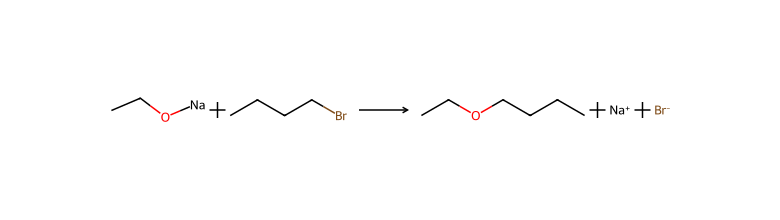
Et–O⁻ Na⁺ + n-Bu–Br → Et–O–Bu + NaBr↓
Textbook SN2 ether-formation. Sodium ethoxide (typically generated in situ from NaH + EtOH or used as a solid) attacks the primary alkyl bromide via backside attack; the bromide leaves as NaBr, precipitating from DMF as the reaction advances. Primary substrates only — secondary alkyl halides give E2 elimination at these conditions because the alkoxide is sterically demanding.
Conditions: Generate the alkoxide: under N2, suspend NaH (60% in mineral oil, 1.05 equiv) in dry DMF (~3 mL per mmol substrate). Add ethanol (1.05 equiv) dropwise — vigorous H2 evolution; control addition rate. Once H2 stops, add 1-bromobutane (1.0 equiv) via syringe. Stir at 50–80 °C for 6–24 h until starting material is consumed (TLC). NaBr precipitates as a fine white solid. Workup — Quench with sat. NH4Cl; partition into Et2O / water; wash organic with water + brine; dry MgSO4; concentrate. Distil at atmospheric pressure (bp 92 °C) to isolate. Substrate-scope reminder: Williamson works ONLY for primary alkyl halides.
- Expected yield
- 70–88 %
- Expected duration
- 6–24 h at 50–80 °C after in-situ alkoxide generation
Reagents
| Reagent | Role | Equiv | MW | ρ |
|---|---|---|---|---|
|
109-65-9
109-65-9 · C4H9Br
1-Bromobutane — limiting reagent; primary alkyl bromide is the textbook substrate. Distil before use to remove HBr and any 2-bromobutane impurity. Switching to the iodide (1-iodobutane) accelerates the SN2 ~10x but invites side reactions; the bromide is the safer bet. |
reactant | 1.0 | 137.02 | 1.270 |
|
Sodium Ethoxide
141-52-6 · C2H6NaO
Sodium ethoxide — nucleophile. Often generated in-situ from NaH + EtOH (cleaner than the commercial solid which absorbs CO2 + moisture). Slight excess to drive the SN2 to completion. |
reactant | 1.05 | 69.06 | 0.870 |
|
68-12-2
68-12-2 · C3H7NO
DMF — polar aprotic, stabilises the alkoxide free of H-bond donor that would protonate it. DMSO is an alternative; THF works if the alkoxide is generated in situ but slows the SN2. |
solvent | — | 73.10 | 0.940 |
|
628-81-9
628-81-9 · C6H14O
Ethyl butyl ether — colourless liquid, bp 92 °C; ethereal smell; pungent at high concentrations. Dry over 4 Å sieves for use as an anhydrous solvent in subsequent steps. |
product | 1.0 | 102.18 | — |
Actions
- Open in Reaction Scale Calculator →
- Or jump straight to 109-65-9 at: 1 mmol 10 mmol 100 mmol
- Mechanism / source ↗
- View as JSON ↗
Search literature
More Substitution reactions
- A GENERAL PROCEDURE FOR MITSUNOBU INVERSION OF STERICALLY HINDERED ALCOHOLS: INVERSION OF MENTHOL. (1S,2S,5R)-5-METHYL-2-(1-METHYLETHYL)CYCLOHEXYL 4-NITROBENZOATE (Cyclohexanol, 5-methyl-2-(1-methylethyl)-, 4-nitrobenzoate, [1S-(1α,2α,5β)]-) Substitution
- Appel reaction Substitution
- Catalytic Intramolecular Friedel-Crafts Reaction of Benzyl Meldrum's Acid Derivatives: Preparation of 5,6-Dimethoxy-2-Methyl-1-Indanone Electrophilic aromatic substitution
- Finkelstein reaction Substitution
- Friedel-Crafts acylation: benzene + acetyl chloride → acetophenone Electrophilic aromatic substitution
- Indium-Catalyzed Heteroaryl–Heteroaryl Bond Formation through Nucleophilic Aromatic Substitution: Preparation of 2-Methyl-3-(thien-2-yl)-1H-indole Substitution