Reactions · Wittig 1954 ↗
Wittig olefination: methyltriphenylphosphonium bromide + benzaldehyde → styrene
Overview
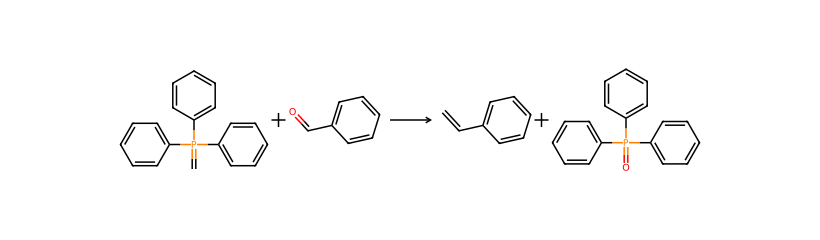
[Ph3P=CH2] + Ar–CHO → Ar–CH=CH2 + Ph3P=O
Canonical Wittig olefination — the textbook 'make an alkene from an aldehyde' demo. The ylide (methylenetriphenylphosphorane) is generated in situ from methyltriphenylphosphonium bromide + base (typically n-BuLi at −78 °C, or NaH in DMSO), then reacts with benzaldehyde to give styrene. The triphenylphosphine oxide byproduct precipitates from cold ether and is the diagnostic end-of-reaction signal.
Conditions: Step 1 — Suspend Ph3P+CH3 Br− (1.05 equiv) in dry THF under N2; cool to −78 °C; add n-BuLi (1.05 equiv, 2.5 M in hexanes) dropwise. Stir 30 min — solution turns yellow-orange (ylide formation). Step 2 — Add benzaldehyde (1.0 equiv) dropwise; warm to RT over 1–2 h; stir 4–12 h. Workup — Quench with sat. NH4Cl; extract with Et2O; wash brine; dry MgSO4. Concentrate carefully (styrene is volatile, bp 145 °C). Triphenylphosphine oxide precipitates from cold pentane/ether — filter off. Distil residue under reduced pressure for clean styrene.
- Expected yield
- 70–88 %
- Expected duration
- 4–12 h at RT after −78 °C ylide formation
Reagents
| Reagent | Role | Equiv | MW | ρ |
|---|---|---|---|---|
|
1779-49-3
1779-49-3 · C19H18BrP
Methyltriphenylphosphonium bromide — ylide precursor; slight excess so the aldehyde is the limiting reagent. |
reactant | 1.05 | 357.23 | — |
|
Benzaldehyde
100-52-7 · C7H6O
Benzaldehyde — the substrate aldehyde; freshly distilled to remove benzoic acid (white film on bottle indicates oxidation). |
reactant | 1.0 | 106.12 | 1.050 |
|
109-99-9
109-99-9 · C4H8O
Tetrahydrofuran — anhydrous; degas with N2 sparge before use. DMSO is a common alternative when NaH is the base instead of n-BuLi. |
solvent | — | 72.11 | 0.890 |
|
Styrene
100-42-5 · C8H8
Styrene — colourless liquid, bp 145 °C; polymerises on standing (stabilise with 4-tert-butylcatechol if storing). Pungent sweet odour. |
product | 1.0 | 104.15 | 0.910 |
Actions
- Open in Reaction Scale Calculator →
- Or jump straight to Benzaldehyde at: 1 mmol 10 mmol 100 mmol
- Mechanism / source ↗
- View as JSON ↗
Search literature
More Olefination reactions
- 1,2-Wittig rearrangement Olefination
- 2,3-Wittig rearrangement Olefination
- Aza-Wittig reaction Olefination
- GENERATION OF YNOLATE AND Z-SELECTIVE OLEFINATION OF ACYLSILANES: (Z)-2-METHYL-3-TRIMETHYLSILYL-2-BUTENOIC ACID ((Z)-2-Butenoic acid, 2-methyl-3-trimethylsilyl-) Olefination
- Julia olefination Olefination
- Kauffmann olefination Olefination