Reactions · Friedel-Crafts 1877 ↗
Friedel-Crafts acylation: benzene + acetyl chloride → acetophenone
Overview
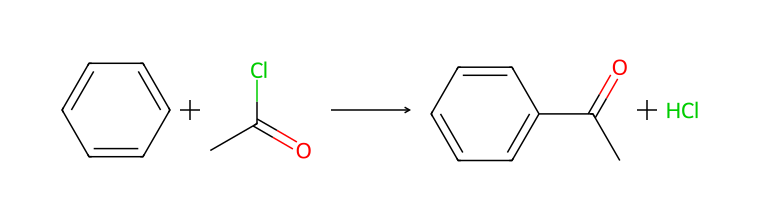
PhH + CH3–C(=O)–Cl → Ph–C(=O)–CH3 + HCl
Textbook electrophilic aromatic substitution via the AlCl3-generated acylium ion. The product ketone (acetophenone) deactivates the ring toward further acylation, so unlike F-C alkylation, monoacylation is clean — no polyacylation problem. AlCl3 is used at 1.1 equiv (not catalytic) because it complexes the product 1:1; aqueous acidic workup decomposes the complex to free the ketone.
Conditions: Suspend AlCl3 (1.1 equiv) in dry CH2Cl2 (~3 mL per mmol acetyl chloride) under N2. Cool to 0 °C; add acetyl chloride (1.0 equiv, slowly via syringe — exotherm!). The mixture turns yellow-brown as the AlCl3-AcCl complex forms. Add benzene (1.05 equiv, slight excess) dropwise over 10 min keeping T < 5 °C. Warm to RT; stir 1–4 h until HCl evolution ceases. Workup — Cautiously pour onto crushed ice; separate organic; wash with sat. NaHCO3 (decomposes residual AlCl3 complex), water, brine; dry MgSO4; concentrate. Distil at reduced pressure (bp 202 °C at 760 mmHg, or ~80 °C at 10 mmHg). Pure acetophenone is a colourless liquid with a sweet almond-like odour.
- Expected yield
- 72–88 %
- Expected duration
- 1–4 h at RT after 0 °C addition; HCl evolution is the endpoint signal
Reagents
| Reagent | Role | Equiv | MW | ρ |
|---|---|---|---|---|
|
71-43-2
71-43-2 · C6H6
Benzene — slight excess; suppresses polyacylation (already kinetically disfavoured by ring deactivation, but excess locks this in). Carcinogen — strict hood discipline. |
reactant | 1.05 | 78.11 | 0.880 |
|
Acetyl Chloride
75-36-5 · C2H3ClO
Acetyl chloride — limiting reagent. Moisture-sensitive (hydrolyses to acetic acid + HCl); transfer by syringe under N2. Stench is characteristic — work in a hood. |
reactant | 1.0 | 78.50 | 1.110 |
|
Aluminium Chloride
7446-70-0 · AlCl3
Aluminum chloride (anhydrous) — Lewis acid. Listed at 1.1 equiv rather than catalytic because the ketone product complexes the AlCl3 1:1; stoichiometric load is needed to keep free AlCl3 available for the next turnover. Aqueous workup decomposes the complex. |
catalyst | 1.1 | 133.34 | 2.480 |
|
Dichloromethane
SDS
75-09-2 · CH2Cl2
Dichloromethane — anhydrous. Chlorobenzene (108-90-7) and carbon disulfide (also classic) are alternatives but DCM is the modern bench standard. Excludes water — AlCl3 reacts violently with H2O. |
solvent | — | 84.93 | 1.330 |
|
Acetophenone
98-86-2 · C8H8O
Acetophenone — colourless liquid, bp 202 °C; sweet almond/hawthorn-like odour. Used industrially as a fragrance ingredient and pharmaceutical intermediate (e.g. ephedrine synthesis). |
product | 1.0 | 120.15 | 1.030 |
Actions
- Open in Reaction Scale Calculator →
- Or jump straight to Acetyl Chloride at: 1 mmol 10 mmol 100 mmol
- Mechanism / source ↗
- View as JSON ↗