Reduction reactions
3,374 reactions: 10 worked examples with a reagent table you can scale, 503 named reactions and 2,861 checked procedures from Organic Syntheses.
1–24 of 58
- Béchamp reductionReduction The Béchamp reduction (or Béchamp process) is a chemical reaction that converts aromatic nitro compounds to their corresponding anilines using iron as the reductant.
- Birch reductionReduction The Birch reduction or Metal-Ammonia reduction is an organic reaction that is used to convert arenes to 1,4-cyclohexadienes.
- Bouveault–Blanc reductionReduction The Bouveault–Blanc reduction is a chemical reaction in which an ester is reduced to primary alcohols using absolute ethanol and sodium metal.
- Clemmensen reductionReduction Clemmensen reduction is a chemical reaction described as a reduction of ketones or aldehydes to alkanes using zinc amalgam and concentrated hydrochloric acid (HCl).
- Corey–Itsuno reductionReduction The Corey–Itsuno reduction, also known as the Corey–Bakshi–Shibata (CBS) reduction, is a chemical reaction in which a prochiral ketone is enantioselectively reduced to produce the corresponding chiral, non-racemic alcohol.
- Evans–Saksena reductionReduction The Saksena–Evans reduction is a diastereoselective reduction of β-hydroxy ketones to the corresponding anti-dialcohols, employing the reagent tetramethylammonium triacetoxyborohydride (Me4NHB(OAc)3).
- Fukuyama reductionReduction The Fukuyama reduction is an organic reaction and an organic reduction in which a thioester is reduced to an aldehyde by a silyl hydride in presence of a catalytic amount of palladium.
- Luche reductionReduction Luche reduction is the selective organic reduction of α,β-unsaturated ketones to allylic alcohols.
- Meerwein–Ponndorf–Verley reductionReduction The Meerwein–Ponndorf–Verley (MPV) reduction in organic chemistry is the reduction of ketones and aldehydes to their corresponding alcohols utilizing aluminium alkoxide catalysis in the presence of a sacrificial alcohol.
- Mozingo reductionReduction The Mozingo reduction, also known as Mozingo reaction or thioketal reduction, is a chemical reaction capable of fully reducing a ketone or aldehyde to the corresponding alkane via a dithioacetal.
- Narasaka–Prasad reductionReduction The Narasaka–Prasad reduction, sometimes simply called Narasaka reduction, is a diastereoselective reduction of β-hydroxy ketones to the corresponding syn-dialcohols.
- Rosenmund reductionReduction The Rosenmund reduction is a hydrogenation process in which an acyl chloride is selectively reduced to an aldehyde.
- Staudinger reactionReduction The Staudinger reaction is a chemical reaction of an organic azide with a phosphine or phosphite produces an iminophosphorane.
- Staudinger synthesisReduction The Staudinger synthesis, also called the Staudinger ketene-imine cycloaddition, is a chemical synthesis in which an imine 1 reacts with a ketene 2 through a non-photochemical 2+2 cycloaddition to produce a β-lactam 3.
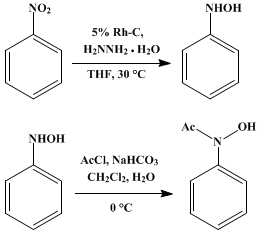
- N-Acetyl-N-phenylhydroxylamine via catalytic transfer hydrogenation of nitrobenzene using hydrazine and rhodium on carbonReduction
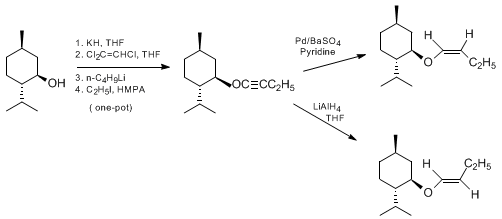
- Acetylenic ethers from alcohols and their reduction to Z- and E-enol ethers: preparation of 1-menthoxy-1-butyne from menthol and conversion to (Z)- and (E)-1-menthoxy-1-buteneReduction
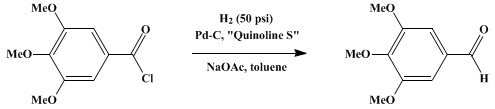
- Aldehydes from acid chlorides by modified Rosenmund reduction: 3,4,5-trimethoxybenzaldehydeReduction
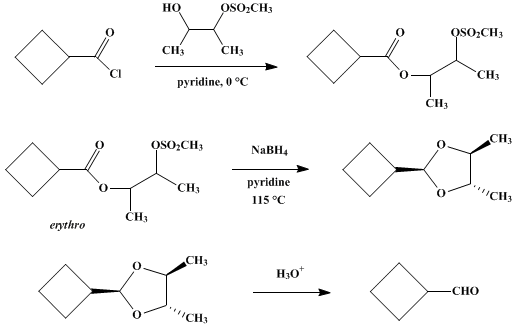
- Aldehydes from acid chlorides by reduction of ester-mesylates with sodium borohydride: cyclobutanecarboxaldehydeReduction
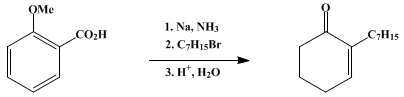
- Alkylation of the anion from Birch reduction of o-anisic acid: 2-heptyl-2-cyclohexenoneReduction
- Apparatus for catalytic reductionReduction
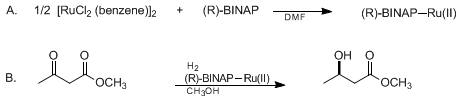
- Asymmetric hydrogenation of 3-oxo carboxylates using BINAP-ruthenium complexes: (R)-(−)-methyl 3-hydroxybutanoateReduction
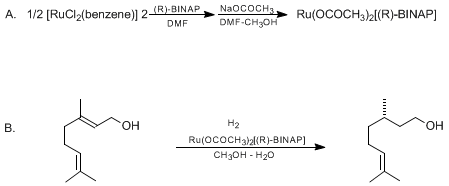
- Asymmetric hydrogenation of allylic alcohols using BINAP-ruthenium complexes: (S)-(−)-citronellolReduction
- Asymmetric hydrogenation of ketopantoyl lactone: D-(−)-pantoyl lactoneReduction
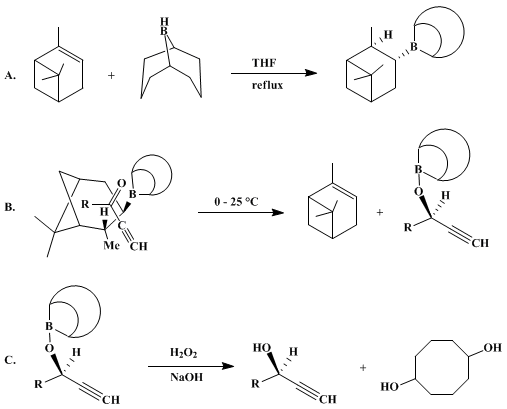
- Asymmetric reduction of α,β-acetylenic ketones with B-3-pinanyl-9-borabicyclo[3.3.1]nonane: (R)-(+)-1-octyn-3-olReduction


Page 1 of 3