Condensation reactions
3,374 reactions: 10 worked examples with a reagent table you can scale, 503 named reactions and 2,861 checked procedures from Organic Syntheses.
1–24 of 32
- Claisen-Schmidt aldol: benzaldehyde + acetone → benzalacetoneCondensationC-C bond formation Textbook aldol condensation. Scale
- Aldol–Tishchenko reactionCondensation The Aldol–Tishchenko reaction is a tandem reaction involving an aldol reaction and a Tishchenko reaction.
- Dieckmann condensationCondensation The Dieckmann condensation is the intramolecular chemical reaction of diesters with base to give β-keto esters.
- Grieco three-component condensationCondensation The Grieco three-component condensation is an organic chemistry reaction that produces nitrogen-containing six-member heterocycles via a multi-component reaction of an aldehyde, a nitrogen component, such as aniline, and an electron-rich alkene.
- Japp–Maitland condensationCondensation The Japp–Maitland condensation is an organic reaction and a type of Aldol reaction and a tandem reaction.
- Knoevenagel condensationCondensation In organic chemistry, the Knoevenagel condensation (pronounced [ˈknøːvənaːɡl̩]) reaction is a type of chemical reaction named after German chemist Emil Knoevenagel.
- Mukaiyama aldol additionCondensation In organic chemistry, the Mukaiyama aldol addition is an organic reaction and a type of aldol reaction between a silyl enol ether (R2C=CR−O−Si(CH3)3) and an aldehyde (R−CH=O) or formate (R−O−CH=O).
- Mukaiyama hydrationCondensation The Mukaiyama hydration is an organic reaction involving formal addition of an equivalent of water across an olefin by the action of catalytic bis(acetylacetonato)cobalt(II) complex, phenylsilane and atmospheric oxygen to produce an alcohol with Markovnikov selectivity.
- Pechmann condensationCondensation The Pechmann condensation is a synthesis of coumarins, starting from a phenol and a carboxylic acid or ester containing a β-carbonyl group.
- Perkin reactionCondensation The Perkin reaction is an organic reaction developed by English chemist William Henry Perkin in 1868 that is used to make cinnamic acids.
- Perkin rearrangementCondensation The Perkin rearrangement (coumarin–benzofuran ring contraction) is a rearrangement reaction in which a 2-halocoumarin in the presence of hydroxide undergoes a ring contraction to form a benzofuran.
- Stobbe condensationCondensation The Stobbe condensation entails the reaction of an aldehyde or ketone with an ester of succinic acid to generate alkylidene succinic acid or related derivatives.
- Ullmann condensationCondensation The Ullmann condensation or Ullmann-type reaction is the copper-promoted conversion of aryl halides to aryl ethers, aryl thioethers, aryl nitriles, and aryl amines.
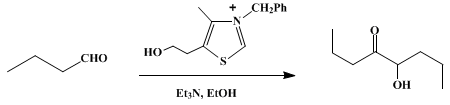
- Acyloin condensation by thiazolium ion catalysis: butyroinCondensation
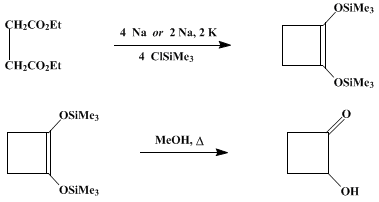
- Acyloin condensation in which chlorotrimethylsilane is used as a trapping agent: 1,2-bis(trimethylsilyloxy)cyclobutene and 2-hydroxycyclobutanoneCondensation
- Amide formation by decarboxylative condensation of hydroxylamines and α-ketoacids: N-[(1S)-1 phenylethyl]-benzeneacetamideCondensation
- Catalytic asymmetric acyl halide-aldehyde cyclocondensation reactionCondensation
- Catalytic asymmetric synthesis of nitroaldols using a lanthanum-lithium-BINOL complex: (2S,3S)-2-nitro-5-phenyl-1,3-pentanediolCondensation
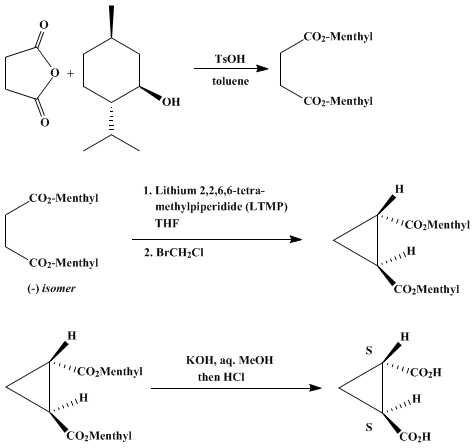
- Condensation of (−)-dimenthyl succinate dianion with 1,ω-dihalides: (+)-(1S,2S)-cyclopropane-1,2-dicarboxylic acidCondensation
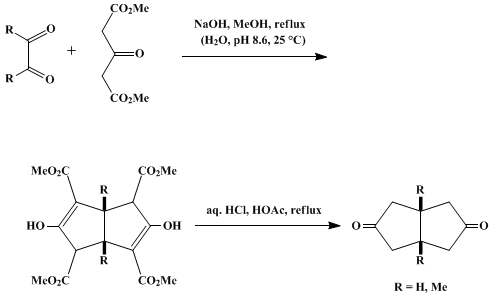
- Condensation of dimethyl 1,3-acetonedicarboxylate with 1,2-dicarbonyl compounds: cis-bicyclo[3.3.0]octane-3,7-dionesCondensation
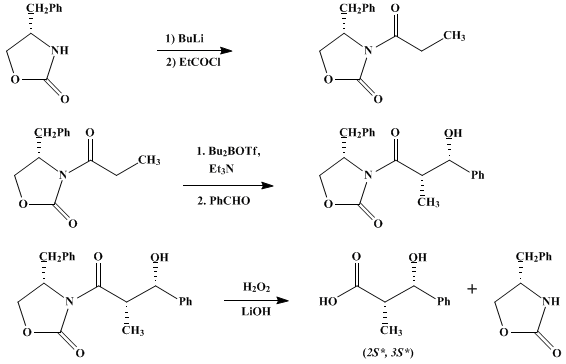
- Diastereoselective aldol condensation using a chiral oxazolidinone auxiliary: (2S*,3S*)-3-hydroxy-3-phenyl-2-methylpropanoic acidCondensation
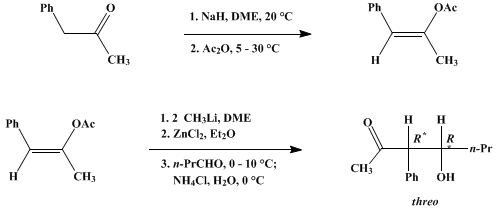
- Directed aldol condensations: threo-4-hydroxy-3-phenyl-2-heptanoneCondensation
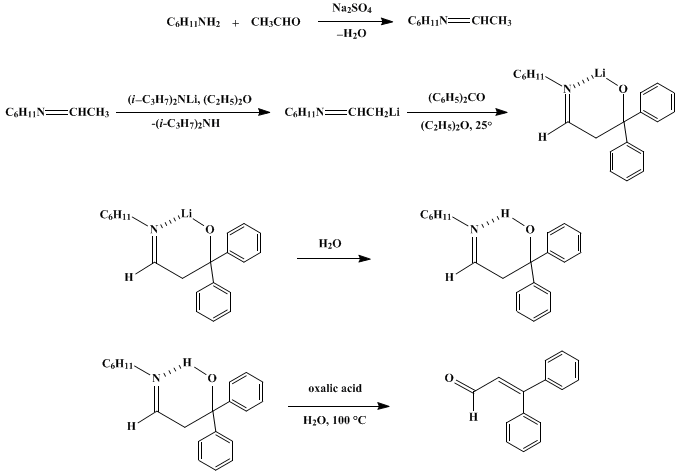
- Directed aldol condensations: β-phenylcinnamaldehydeCondensation
- Enantioselective Nitroaldol (Henry) Reaction of p-Nitrobenzaldehyde and Nitromethane Using a Copper (II) Complex Derived from (R,R)-1,2-Diaminocyclohexane: (1S)-1-(4-Nitrophenyl)-2-nitroethane-1-olCondensation
Page 1 of 2