Substitution reactions
3,374 reactions: 10 worked examples with a reagent table you can scale, 503 named reactions and 2,861 checked procedures from Organic Syntheses.
1–12 of 12
- Mitsunobu reaction: benzyl alcohol + phthalimide → N-benzyl phthalimideSubstitutiondehydration PPh3/DIAD-mediated dehydrative coupling of an alcohol with an acidic pronucleophile (pKa ≲ 13). Scale
- Williamson ether synthesis: sodium ethoxide + 1-bromobutane → ethyl butyl etherSubstitutionSN2 Textbook SN2 ether-formation. Scale
- Appel reactionSubstitution The Appel reaction is an organic reaction that converts an alcohol into an alkyl chloride using triphenylphosphine and carbon tetrachloride.
- Finkelstein reactionSubstitution The Finkelstein reaction, named after the German chemist Hans Finkelstein, is a type of SN2 reaction (substitution nucleophilic bimolecular reaction) that involves the exchange of one halogen atom for another.
- Mitsunobu reactionSubstitution The Mitsunobu reaction is an organic reaction that converts an alcohol into a variety of functional groups, such as an ester, using triphenylphosphine and an azodicarboxylate such as diethyl azodicarboxylate (DEAD) or diisopropyl azodicarboxylate (DIAD).
- Vicarious nucleophilic substitutionSubstitution In organic chemistry, the vicarious nucleophilic substitution is a special type of nucleophilic aromatic substitution in which a nucleophile replaces a hydrogen atom on the aromatic ring and not leaving groups such as halogen substituents which are ordinarily encountered in SNAr.
- Williamson ether synthesisSubstitutionSN2 The Williamson ether synthesis is an organic reaction, forming an ether from an organohalide and a deprotonated alcohol (alkoxide).
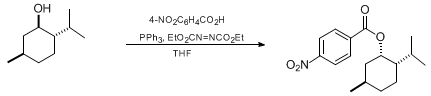
- A general procedure for Mitsunobu inversion of sterically hindered alcohols: inversion of menthol. (1S,2S,5R)-5-Methyl-2-(1-methylethyl)cyclohexyl 4-nitrobenzoateSubstitution
- Indium-Catalyzed Heteroaryl–Heteroaryl Bond Formation through Nucleophilic Aromatic Substitution: Preparation of 2-Methyl-3-(thien-2-yl)-1H-indoleSubstitution
- Nucleophilic aromatic substitution of aryl fluorides by secondary nitriles: preparation of 2-(2-methoxyphenyl)-2-methylpropionitrileSubstitution
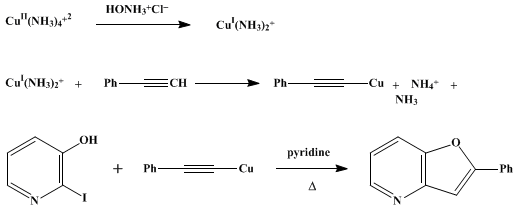
- Substitution of aryl halides with copper(I) acetylides: 2-phenylfuro[3,2-b]pyridineSubstitution
- Substitution reactions of 2-benzenesulfonyl cyclic ethers: tetrahydro-2-(phenylethynyl)-2H-pyranSubstitution