Reactions · Suzuki 1979 ↗
Suzuki–Miyaura coupling: 4-bromobenzonitrile + phenylboronic acid → 4-cyanobiphenyl
Overview
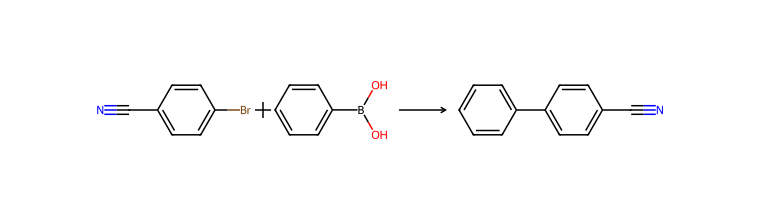
Ar–Br + Ar'–B(OH)₂ → Ar–Ar' (Pd(0), base)
Canonical Pd(0)-catalysed cross-coupling of an aryl halide with an aryl boronic acid. The 4-cyanobiphenyl target is the textbook demonstration substrate — electron-poor aryl halide + electron-rich boronic acid, matched polarity for a clean transmetalation. Same pair appears in the ORD-shaped test fixture at tests/fixtures/ord/suzuki_simple.json.
Conditions: Pd(PPh3)4 (5 mol%), K2CO3 (2 equiv, heterogeneous solid base), 1,4-dioxane (or dioxane:H2O 4:1 for hydrolytically robust substrates). Reflux 80–90 °C, 4–24 h. Argon or N2 atmosphere. Workup: cool, partition between EtOAc + brine, wash organic with sat. NaHCO3 + brine, dry MgSO4, concentrate, recrystallise from EtOH or chromatograph (hexane/EtOAc).
- Expected yield
- 70–85 %
- Expected duration
- 4–24 h at 80–90 °C (reflux)
Reagents
| Reagent | Role | Equiv | MW | ρ |
|---|---|---|---|---|
|
623-00-7
623-00-7 · C7H4BrN
4-Bromobenzonitrile — electron-poor aryl halide; coupling partner. |
reactant | 1.0 | 182.02 | — |
|
Phenylboronic Acid
98-80-6 · C6H7BO2
Phenylboronic acid — electron-rich aryl boronic acid; slight excess to compensate for protodeboronation. |
reactant | 1.1 | 121.93 | — |
|
Tetrakis(Triphenylphosphine)Palladium
14221-01-3 · C72H60P4Pd
Tetrakis(triphenylphosphine)palladium(0) — 5 mol%. Air-stable enough for bench setup but degas anyway. |
catalyst | 0.05 | 1155.59 | — |
|
123-91-1
123-91-1 · C4H8O2
1,4-Dioxane — primary solvent. Often used as 4:1 dioxane/H2O for boronic-acid solubility; the calculator does not split solvent volumes, so adjust by hand if you want the aqueous mix. |
solvent | — | 88.11 | 1.030 |
|
2920-38-9
2920-38-9 · C13H9N
4-Cyanobiphenyl — pale-yellow crystalline; mp 86–88 °C; recrystallises from EtOH. |
product | 1.0 | 179.22 | — |
Actions
- Open in Reaction Scale Calculator →
- Or jump straight to 623-00-7 at: 1 mmol 10 mmol 100 mmol
- Mechanism / source ↗
- View as JSON ↗
Search literature
More Cross-coupling reactions
- 2-(4-METHOXYPHENYL)-2-CYCLOHEXEN-1-ONE: PREPARATION OF 2-IODO-2-CYCLOHEXEN-1-ONE AND SUZUKI COUPLING WITH 4-METHOXYPHENYLBORONIC ACID (2-Cyclohexen-1-one, 2-(4-methoxyphenyl)- and 2-Cyclohexen-1-one, 2-iodo-)) Cross-coupling
- ACCELERATED SUZUKI COUPLING VIA A LIGANDLESS PALLADIUM CATALYST: 4-METHOXY-2'-METHYLBIPHENYL (1,1'-Biphenyl, 4'-methoxy-2-methyl-) Cross-coupling
- ALKYNYL(PHENYL)IODONIUM TOSYLATES: PREPARATION AND STEREOSPECIFIC COUPLING WITH VINYLCOPPER REAGENTS. FORMATION OF CONJUGATED ENYNES. 1-HEXYNYL(PHENYL)IODONIUM TOSYLATE AND (E)-5-PHENYLDODEC-5-EN-7-YNE (Iodine, 1-hexynyl(4-methylbenzenesulfonato-O)phenyl- and Benzene, (1-butyl-1-octen-3-ynyl)-, (E)-) Cross-coupling
- B-PROTECTED HALOBORONIC ACIDS FOR ITERATIVE CROSS-COUPLING Cross-coupling
- Buchwald–Hartwig amination Cross-coupling
- Cadiot–Chodkiewicz coupling Cross-coupling