Reactions · Mitsunobu 1967 ↗
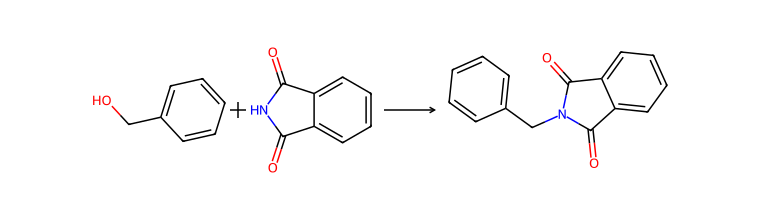
Mitsunobu reaction: benzyl alcohol + phthalimide → N-benzyl phthalimide
Overview
R–OH + Nu–H + PPh3 + DIAD → R–Nu + PPh3=O + reduced DIAD
PPh3/DIAD-mediated dehydrative coupling of an alcohol with an acidic pronucleophile (pKa ≲ 13). Phthalimide as the nucleophile gives an N-alkyl phthalimide that hydrolyses to the free primary amine — the classic Gabriel-like sequence. SN2 mechanism with clean inversion of configuration at the alcohol carbon. PPh3 is oxidised to PPh3=O; DIAD is reduced to the corresponding hydrazine. Both byproducts complicate purification — chromatography is usually required.
Conditions: PPh3 (1.1 equiv) and DIAD (1.1 equiv) in dry THF (1.0 M based on alcohol). Add DIAD slowly to a stirred mixture at 0 °C, then warm to room temperature and stir for 4–12 h (overnight is safest). Argon atmosphere; DIAD reduces explosively at >100 °C. Workup: concentrate, redissolve in EtOAc, wash with sat. NaHCO3 + brine, dry MgSO4, evaporate. Column chromatography (hexane/EtOAc, gradient) removes PPh3=O and the spent hydrazine.
- Expected yield
- 70–90 %
- Expected duration
- 4–12 h (commonly overnight) at 0 °C → room temperature
Reagents
| Reagent | Role | Equiv | MW | ρ |
|---|---|---|---|---|
|
Benzyl Alcohol
100-51-6 · C7H8O
Benzyl alcohol — primary alcohol; SN2 happens with inversion at this carbon. |
reactant | 1.0 | 108.14 | 1.040 |
|
Phthalimide
85-41-6 · C8H5NO2
Phthalimide — acidic NH (pKa ~8.3), comfortably below the Mitsunobu's ~13 pKa cutoff. Slight excess to compensate for incomplete deprotonation. |
reactant | 1.1 | 147.13 | — |
|
2446-83-5
2446-83-5 · C8H14N2O4
Diisopropyl azodicarboxylate (DIAD) — stoichiometric oxidant; reduced to the corresponding hydrazine. Add slowly at 0 °C; explosive on heating. |
catalyst | 1.1 | 202.21 | — |
|
603-35-0
603-35-0 · C18H15P
Triphenylphosphine — stoichiometric reductant; oxidised to PPh3=O. Marked 'catalyst' in our schema for participant-table layout, but is consumed by the reaction. |
catalyst | 1.1 | 262.29 | 1.080 |
|
109-99-9
109-99-9 · C4H8O
Dry THF — standard Mitsunobu solvent. Use freshly distilled or recently-opened anhydrous bottle; trace water deactivates the betaine intermediate. |
solvent | — | 72.11 | 0.890 |
|
2142-01-0
2142-01-0 · C15H11NO2
N-Benzyl phthalimide — white crystalline; mp 116 °C; recrystallises from EtOH. Hydrolyse with hydrazine in EtOH to liberate benzylamine (Gabriel synthesis). |
product | 1.0 | 237.26 | — |
Actions
- Open in Reaction Scale Calculator →
- Or jump straight to Benzyl Alcohol at: 1 mmol 10 mmol 100 mmol
- Mechanism / source ↗
- View as JSON ↗
Search literature
More Substitution reactions
- A GENERAL PROCEDURE FOR MITSUNOBU INVERSION OF STERICALLY HINDERED ALCOHOLS: INVERSION OF MENTHOL. (1S,2S,5R)-5-METHYL-2-(1-METHYLETHYL)CYCLOHEXYL 4-NITROBENZOATE (Cyclohexanol, 5-methyl-2-(1-methylethyl)-, 4-nitrobenzoate, [1S-(1α,2α,5β)]-) Substitution
- Appel reaction Substitution
- Catalytic Intramolecular Friedel-Crafts Reaction of Benzyl Meldrum's Acid Derivatives: Preparation of 5,6-Dimethoxy-2-Methyl-1-Indanone Electrophilic aromatic substitution
- Finkelstein reaction Substitution
- Friedel-Crafts acylation: benzene + acetyl chloride → acetophenone Electrophilic aromatic substitution
- Indium-Catalyzed Heteroaryl–Heteroaryl Bond Formation through Nucleophilic Aromatic Substitution: Preparation of 2-Methyl-3-(thien-2-yl)-1H-indole Substitution