Reactions · Cannizzaro 1853 ↗
Cannizzaro disproportionation: 2 benzaldehyde → benzyl alcohol + sodium benzoate
Overview
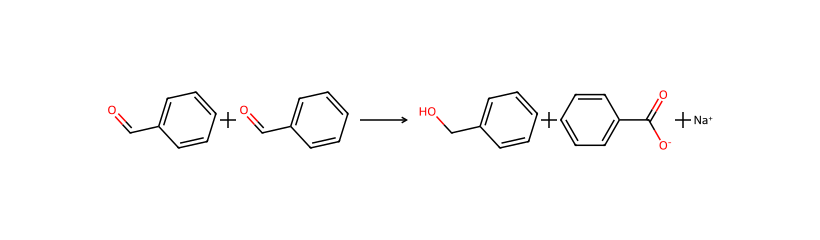
2 Ph–CHO + NaOH → Ph–CH2–OH + Ph–COO⁻ Na⁺
Textbook redox disproportionation of an α-H-free aldehyde. Concentrated NaOH drives hydride transfer between two benzaldehyde molecules: one is reduced to benzyl alcohol, the other oxidised to sodium benzoate. Mechanism goes through a tetrahedral hydride-donor intermediate; chemists isolate the products by acidifying the aqueous phase to precipitate benzoic acid and ether-extracting the alcohol.
Conditions: Dissolve NaOH (1.1 equiv per pair of aldehyde, ~50 wt% aq.) in water. Add benzaldehyde (2.0 equiv) — exotherm; cool with an ice bath to keep T < 30 °C during addition. Stir vigorously (the system rapidly thickens to a paste as the disproportionation advances). Continue stirring 4–24 h at RT until a single phase forms. Workup — Dilute with cold water; extract benzyl alcohol into Et2O (3×). Acidify the aqueous phase with conc. HCl to pH < 2 — benzoic acid precipitates as white needles. Filter, wash with cold water, dry. Recrystallise from hot water. α-H-free aldehydes are the substrate scope (benzaldehyde, furfural, formaldehyde): if the aldehyde has α-H, aldol condensation outcompetes Cannizzaro at the same conditions.
- Expected yield
- 70–88 %
- Expected duration
- 4–24 h at RT after 0–30 °C base addition
Reagents
| Reagent | Role | Equiv | MW | ρ |
|---|---|---|---|---|
|
Benzaldehyde
100-52-7 · C7H6O
Benzaldehyde — both reductant AND oxidant (the same molecule plays both roles in the disproportionation). Freshly distilled; remove benzoic acid (white film on bottle) by 5% NaHCO3 wash before use. |
reactant | 2.0 | 106.12 | 1.050 |
|
Sodium Hydroxide
1310-73-2 · HNaO
Sodium hydroxide — slight excess (1.1 eq per aldehyde pair) so the reaction goes to completion. Used as 50 wt% aqueous solution (~19 M); concentrated NaOH is corrosive — face shield + chemical-resistant gloves. |
catalyst | 1.1 | 40.00 | 2.130 |
|
7732-18-5
7732-18-5 · H2O
Water — co-solvent / reaction medium. The alkali drives the hydride transfer; water solvates the resulting alkoxide. Dilution kills the rate (Cannizzaro is third-order in [base]). |
solvent | — | 18.02 | 1.000 |
|
65-85-0
65-85-0 · C7H6O2
Benzoic acid — the oxidation product; mp 122 °C. Released by acidifying the aqueous phase with conc. HCl. White needles from hot water recrystallisation. |
product | 1.0 | 122.12 | 1.270 |
|
Benzyl Alcohol
100-51-6 · C7H8O
Benzyl alcohol — the reduction product; bp 205 °C. Extract into Et2O after dilution; clean by distillation. |
product | 1.0 | 108.14 | 1.040 |
Actions
- Open in Reaction Scale Calculator →
- Or jump straight to Benzaldehyde at: 1 mmol 10 mmol 100 mmol
- Mechanism / source ↗
- View as JSON ↗