Oxidation reactions
3,374 reactions: 10 worked examples with a reagent table you can scale, 503 named reactions and 2,861 checked procedures from Organic Syntheses.
25–48 of 81
- Pfitzner–Moffatt oxidationOxidation The Pfitzner–Moffatt oxidation, sometimes referred to as simply the Moffatt oxidation, is a chemical reaction for the oxidation of primary and secondary alcohols to aldehydes and ketones, respectively.
- Pinnick oxidationOxidation The Pinnick oxidation is an organic reaction by which aldehydes can be oxidized into their corresponding carboxylic acids using sodium chlorite (NaClO2) under mild acidic conditions.
- Riley oxidationOxidation The Riley oxidation is a selenium dioxide-mediated oxidation of methylene groups adjacent to carbonyls.
- Rubottom oxidationOxidation The Rubottom oxidation is a useful, high-yielding chemical reaction between silyl enol ethers and peroxyacids to give the corresponding α-hydroxy carbonyl product.
- Saegusa–Ito oxidationOxidation The Saegusa–Ito oxidation is a chemical reaction used in organic chemistry.
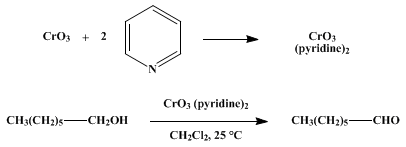
- Sarett oxidationOxidation The Sarett oxidation is an organic reaction that oxidizes primary and secondary alcohols to aldehydes and ketones, respectively, using chromium trioxide and pyridine.
- Sharpless epoxidationOxidation The Sharpless epoxidation reaction is an enantioselective chemical reaction to prepare 2,3-epoxyalcohols from primary and secondary allylic alcohols.
- Shi epoxidationOxidation The Shi epoxidation is a chemical reaction, as the asymmetric epoxidation of alkenes with oxone (potassium peroxymonosulfate) and a fructose-derived catalyst (1).
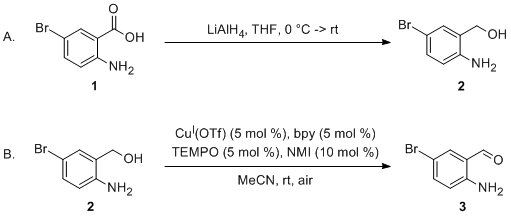
- Stahl oxidationOxidation The Stahl oxidation is a copper-catalyzed aerobic oxidation of primary and secondary alcohols to aldehydes and ketones.
- Swern oxidationOxidation In organic chemistry, the Swern oxidation also known as Moffatt–Swern, named after Daniel Swern, is a chemical reaction whereby a primary or secondary alcohol (−OH) is oxidized to an aldehyde (−CH=O) or ketone (>C=O) using oxalyl chloride, dimethyl sulfoxide (DMSO) and an organic base, such as triethylamine.
- Air Oxidation of Primary Alcohols Catalyzed by Copper(I)/TEMPO. Preparation of 2-Amino-5-bromobenzaldehydeOxidation
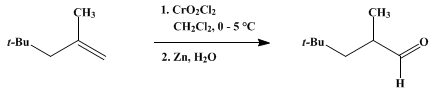
- Aldehydes by oxidation of terminal olefins with chromyl chloride: 2,4,4-trimethylpentanalOxidation
- Aldehydes from primary alcohols by oxidation with chromium trioxide: heptanalOxidation
- Allylic Oxidation Catalyzed by Dirhodium(II) Tetrakis[ε-caprolactamate] of tert-Butyldimethylsilyl-protected trans-DehydroandrosteroneOxidation
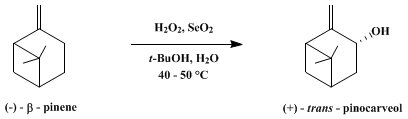
- Allylic oxidation with hydrogen peroxide–selenium dioxide: trans-pinocarveolOxidation
- Anodic oxidation of acids: dimethyl decanedioateOxidation
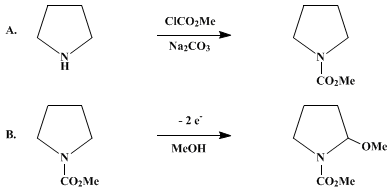
- Anodic oxidation of N-carbomethoxypyrrolidine: 2-methoxy-N-carbomethoxypyrrolidineOxidation
- Asymmetric epoxidation of trans-β-methylstyrene and 1-phenylcyclohexene using a D-fructose-derived ketone: (R,R)-trans-β-methylstyrene oxide and (R,R)-1-phenylcyclohexene oxideOxidation
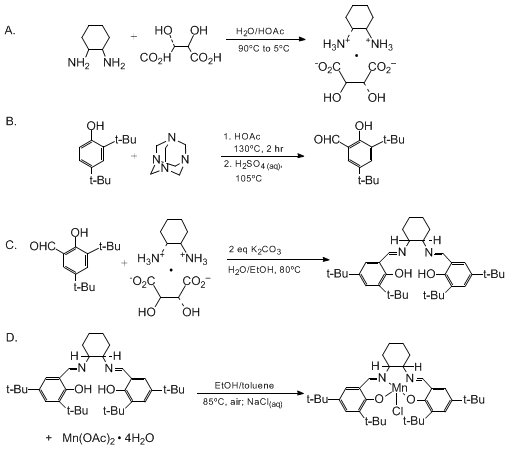
- (R,R)-N,N'-BIS(3,5-DI-tert-BUTYLSALICYLIDENE)-1,2-CYCLOHEXANEDIAMINO MANGANESE(III) CHLORIDE, A HIGHLY ENANTIOSELECTIVE EPOXIDATION CATALYST (Manganese, chloro[[2,2'-[1,2-cyclohexanediylbis(nitrilomethylidyne)]-bis[4,6-bis(1,1-dimethylethyl)phenalato]](2-)-N,N',O,O']-, [SP-5-13-(1R-trans-]-)Oxidation
- Carboxylic acids from the oxidation of terminal alkenes by permanganate: nonadecanoic acidOxidation
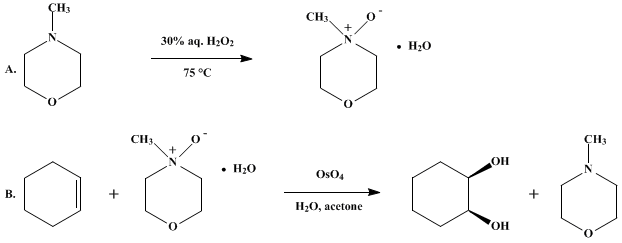
- Catalytic osmium tetroxide oxidation of olefins: cis-1,2-cyclohexanediolOxidation
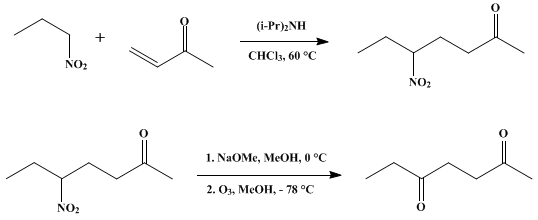
- Conversion of nitro to carbonyl by ozonolysis of nitronates: 2,5-heptanedioneOxidation
- (±) trans-3,3'-(1,2-Cyclopropanediyl)bis-2-(E)-propenoic acid, diethyl ester: tandem oxidation procedure (TOP) using MnO2 oxidation-stabilized phosphorane trappingOxidation
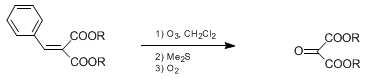
- Dialkyl mesoxalates by ozonolysis of dialkyl benzalmalonates: dimethyl mesoxalateOxidation


Page 2 of 4