Rearrangement reactions
3,374 reactions: 10 worked examples with a reagent table you can scale, 503 named reactions and 2,861 checked procedures from Organic Syntheses.
49–72 of 95
- Piancatelli rearrangementRearrangement In 1976, the Italian chemist, Giovanni Piancatelli and coworkers developed a new method to synthesize 4-hydroxycyclopentenone derivatives from 2-furylcarbinols through an acid-catalyzed rearrangement.
- Pummerer rearrangementRearrangement The Pummerer rearrangement is an organic reaction whereby an alkyl sulfoxide rearranges to an α-acyloxy–thioether (monothioacetal-ester) in the presence of acetic anhydride.
- Schmidt reactionRearrangement In organic chemistry, the Schmidt reaction is an organic reaction in which an azide reacts with a carbonyl derivative, usually an aldehyde, ketone, or carboxylic acid, under acidic conditions to give an amine or amide, with expulsion of nitrogen.
- Skattebøl rearrangementRearrangement The Skattebøl rearrangement is an organic reaction for converting a geminal dihalo cyclopropane to an allene using an organolithium base.
- Smiles rearrangementRearrangement In organic chemistry, the Smiles rearrangement is an organic reaction and a rearrangement reaction named after British chemist Samuel Smiles.
- Sommelet–Hauser rearrangementRearrangement The Sommelet–Hauser rearrangement (named after M. Sommelet and Charles R. Hauser) is a rearrangement reaction of certain benzyl quaternary ammonium salts.
- Stevens rearrangementRearrangement The Stevens rearrangement in organic chemistry is an organic reaction converting quaternary ammonium salts and sulfonium salts to the corresponding amines or sulfides in presence of a strong base in a 1,2-rearrangement.
- Stieglitz rearrangementRearrangement The Stieglitz rearrangement is a rearrangement reaction in organic chemistry which is named after the American chemist Julius Stieglitz (1867–1937) and was first investigated by him and Paul Nicholas Leech in 1913.
- Tiffeneau–Demjanov rearrangementRearrangement The Tiffeneau–Demjanov rearrangement is the chemical reaction of a 1-aminomethyl-cycloalkanol with nitrous acid to form an enlarged cycloketone.
- Wagner–Meerwein rearrangementRearrangement A Wagner–Meerwein rearrangement is a class of carbocation 1,2-rearrangement reactions in which a hydrogen, alkyl or aryl group migrates from one carbon to a neighboring carbon.
- Wallach rearrangementRearrangement The Wallach rearrangement, also named Wallach transformation, is a name reaction in the organic chemistry.
- Westphalen–Lettré rearrangementRearrangement The Westphalen–Lettré rearrangement is a classic organic reaction in organic chemistry describing a rearrangement reaction of cholestane-3β,5α,6β-triol diacetate with acetic anhydride and sulfuric acid.
- Willgerodt rearrangementRearrangement The Willgerodt rearrangement or Willgerodt reaction is an organic reaction converting an aryl alkyl ketone, alkyne, or alkene to the corresponding amide by reaction with ammonium polysulfide, named after Conrad Willgerodt.
- Wolff rearrangementRearrangement The Wolff rearrangement is a reaction in organic chemistry in which an α-diazocarbonyl compound is converted into a ketene by loss of dinitrogen with accompanying 1,2-rearrangement.
- Wolff–Kishner reductionRearrangement The Wolff–Kishner reduction is a reaction used in organic chemistry to convert carbonyl functionalities into methylene groups.
- Wolffenstein–Böters reactionRearrangement The Wolffenstein–Böters reaction is an organic reaction converting benzene to picric acid by a mixture of aqueous nitric acid and mercury(II) nitrate.
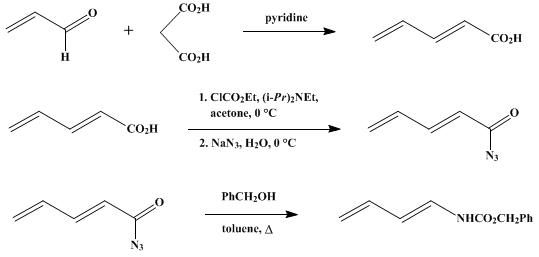
- 1-N-Acylamino-1,3-dienes from 2,4-pentadienoic acids by the Curtius rearrangement: benzyl trans-1,3-butadiene-1-carbamateRearrangement
- Alkenes via Hofmann elimination: use of ion-exchange resin for preparation of quaternary ammonium hydroxides: diphenylmethyl vinyl etherRearrangement
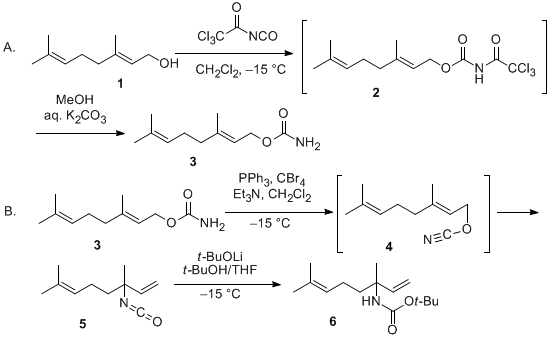
- Allyl Cyanate-To-Isocyanate Rearrangement: Preparation of tert-Butyl 3,7-dimethylocta-1,6-dien-3-ylcarbamateRearrangement
- Asymmetric rearrangement of allylic trichloroacetimidates: preparation of (S)-2,2,2-trichloro-N-(1-propylallyl)acetamideRearrangement
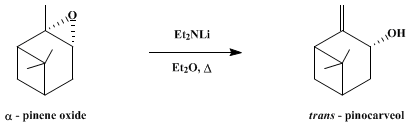
- Base-induced rearrangement of epoxides to allylic alcohols: trans-pinocarveol (Bicyclo[3.3.1]heptan-3-ol, 6,6-dimethyl-2-methylene-, (1α,3α,5α-)Rearrangement
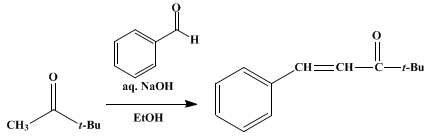
- BenzalpinacoloneRearrangement
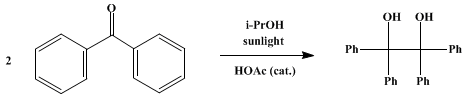
- BenzopinacolRearrangement
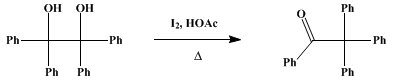
- β-BenzopinacoloneRearrangement

Page 3 of 4